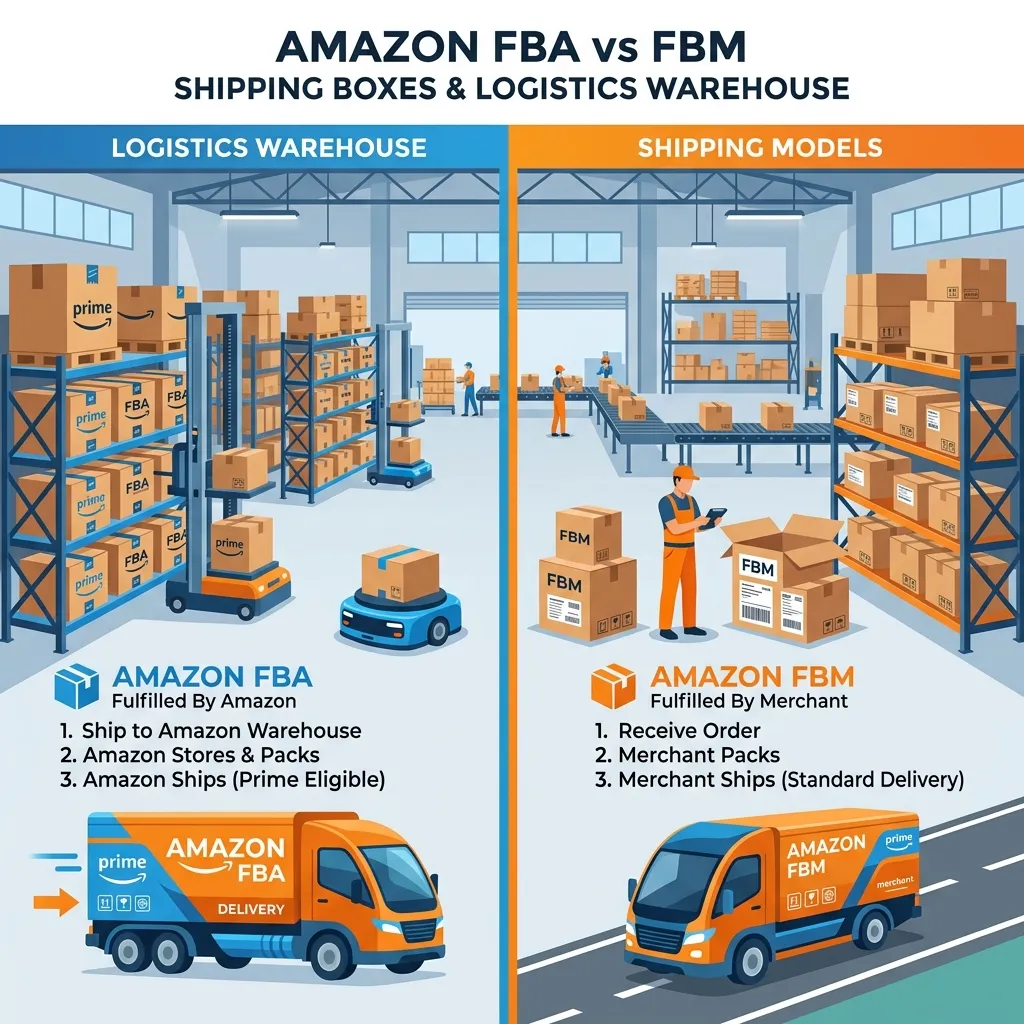
Launching an e-commerce brand on Amazon requires solid logistical decisions. In our team's experience, selecting the correct fulfillment channel is the single most critical factor determining your profit margins and scaling potential. Sellers must choose between FBA and FBM, each offering distinct advantages depending on product sizes and operational capacities.
Fulfillment by Amazon (FBA) Details
Under the FBA model, you ship inventory to Amazon's distribution hubs. They store your inventory, handle picking and packing, deliver packages via Prime, and support customer inquiries. Prime badges boost conversion rates by up to 30%, but storage fees and FBA logistics overheads eat into thin margins.
Fulfillment by Merchant (FBM) Details
Under FBM, you control the storage and shipping. You list the item on Amazon, but pick, pack, and ship orders directly to customers or hire a third-party logistics (3PL) provider. FBM allows you to avoid costly long-term storage fees, but getting Prime badges requires meeting strict Seller Fulfilled Prime standards.
Comparing FBA and FBM Side-by-Side
Consider the following operational guidelines when evaluating your catalog:
- Weight & Size: Small, light goods are highly suited for FBA. Bulky items face high storage penalties and are better handled via FBM.
- Sales Velocity: Slow-moving inventory incurs high storage fees under FBA. High-turnover items thrive in FBA.
- Logistics Infrastructure: If you lack a packing station or warehouse, FBA handles the heavy lifting.
Use our client-side Amazon FBA vs FBM Fee Estimator to input item weights, sizes, and shipping costs to compare exact margin differences instantly.