Amazon Low-Inventory-Level Fee: 2026 Calculator, Historical Days of Supply & Avoidance Guide

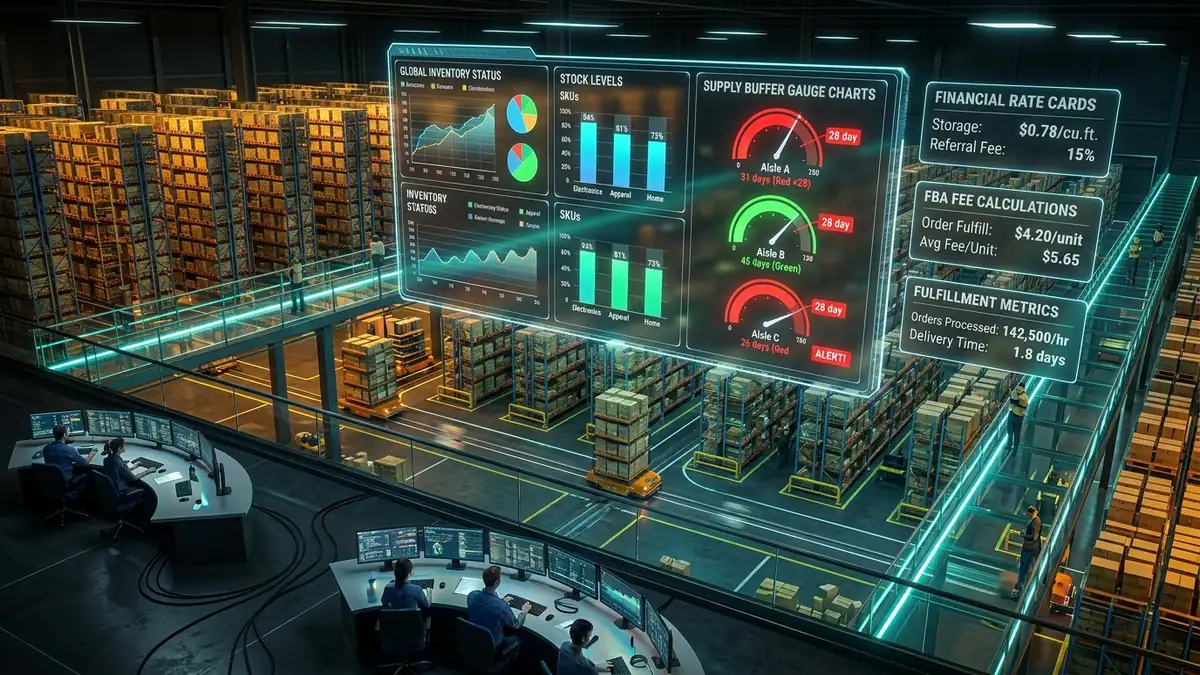
Quick Answer (TL;DR): How the Amazon Low-Inventory-Level Fee Works
The Amazon Low-Inventory-Level Fee is a per-unit surcharge ($0.32 to $1.11+ for standard-size items) applied to outbound customer orders when BOTH your short-term (last 30 days) and long-term (last 90 days) Historical Days of Supply (HDoS) fall below 28 days. The fee is evaluated weekly at the individual child FNSKU level rather than the parent listing. To avoid this margin penalty without triggering aged inventory surcharges, sellers must model lead times with safety stock buffers of 35 to 45 days, utilize automated Amazon Warehousing and Distribution (AWD) replenishment, or calculate exact unit cost impact using our Free Amazon FBA Profit Calculator before submitting stock replenishment plans.
Table of Contents
- 1. The Profit-Siphoning Surcharge: Anatomy of the Low-Inventory-Level Fee
- 2. The Dual-Window Formula: Calculating Historical Days of Supply (HDoS)
- 3. 2026 Fee Schedule Matrix: Rates by Size Tier & Supply Brackets
- 4. Unit Economics: Modeling Margin Compression in Practice
- 5. The FNSKU Variation Trap: Why Parent ASIN Averages Lie
- 6. Surcharge Triad: Low-Inventory vs. Inbound Placement vs. Aged Storage
- 7. 5 Engineering Tactics to Eliminate the Surcharge Without Overstocking
- 8. Frequently Asked Questions (FAQ)
1. The Profit-Siphoning Surcharge: Anatomy of the Low-Inventory-Level Fee
Fulfillment by Amazon (FBA) has historically penalized third-party merchants for carrying excessive inventory through monthly and aged inventory surcharges. In 2024, Amazon inverted this economic architecture by penalizing merchants who maintain lean, just-in-time stock levels. The Low-Inventory-Level Fee represents one of the most aggressive supply chain interventions in marketplace history. Amazon instituted this mechanism to solve an internal regional logistics challenge: when a seller sends insufficient inventory into the fulfillment network, Amazon cannot pre-position units across its eight decentralized regional fulfillment nodes. Consequently, customer orders require long-haul transportation, multi-leg sorting, and air freight, driving up Amazon's internal delivery overhead.
Rather than absorbing those cross-country transfer expenses, Amazon shifts the financial burden directly onto the merchant's profit and loss statement. For sellers operating on tight net margins between 12% and 20%, an unexpected $0.89 surcharge on every unit shipped can obliterate profitability overnight. What makes this penalty particularly dangerous is its delayed visibility: the fee does not appear as an upfront deduction during shipment creation. Instead, it accrues silently on every customer shipment throughout the subsequent operating cycle.
The Merchant's Dilemma
Sellers are squeezed between two opposing financial penalties: send too little inventory and trigger the Low-Inventory-Level Fee ($0.32–$1.11+/unit); send too much inventory and trigger Aged Inventory Surcharges ($7.90/cu.ft.) plus monthly storage fees.
The Optimal Equilibrium Window
Maintaining 35 to 55 days of supply provides complete immunity from the Low-Inventory-Level Fee while remaining safely below the 180-day aged inventory threshold, protecting overall working capital and cash conversion cycles.
Understanding the precise mathematical trigger is the only way to balance this inventory tightrope. Below, we break down the exact dual-window evaluation formula used by Amazon's automated billing engines.
2. The Dual-Window Formula: Calculating Historical Days of Supply (HDoS)
Many sellers mistakenly assume that Amazon evaluates inventory based on simple real-time stock levels. In reality, the fee trigger relies on a backward-looking metric called Historical Days of Supply (HDoS). Amazon calculates this metric by dividing your average daily fulfillable on-hand inventory by your average daily units shipped across two distinct trailing timeframes:
Where Average Daily Units Shipped accounts for outbound customer purchases, and Average Daily Fulfillable Inventory accounts exclusively for units available in fulfillable status (excluding FC transfer, unfulfillable customer returns, and inventory quarantined for hazmat review).
The critical operational nuance lies in Amazon's dual-window evaluation rule. Amazon computes this formula across two independent windows:
- Short-Term Window: The trailing 30 calendar days.
- Long-Term Window: The trailing 90 calendar days.
The Core Exemption Condition: The Low-Inventory-Level Fee is triggered if and only if BOTH the 30-day HDoS and the 90-day HDoS are strictly below 28.0 days. If your 30-day HDoS is 22 days due to an unexpected viral sales spike, but your 90-day historical average is 34 days, you pay $0 in low-inventory fees. Amazon uses the greater of the two historical metrics when evaluating compliance:
Evaluation Metric = Max(30-Day Historical Days of Supply, 90-Day Historical Days of Supply)
If Evaluation Metric ≥ 28 days: Low-Inventory-Level Fee = $0.00.
If Evaluation Metric < 28 days: Low-Inventory-Level Fee is billed according to the rate tier of the greater value.
This rule provides critical breathing room for seasonal surges or supply chain delays, provided your long-term inventory baseline was managed properly.
Calculate Your Net Amazon FBA Margins Instantly
Don't allow hidden fulfillment surcharges, inbound placement fees, and low-inventory penalties to erase your Amazon cash flow. Model exact unit economics, dimensional weight, and referral deductions with our dedicated browser utility.
3. 2026 Fee Schedule Matrix: Rates by Size Tier & Supply Brackets
When both evaluation periods fall below the 28-day threshold, Amazon assesses fees based on a tiered rate schedule. The surcharge is determined by two variables: your product's shipping weight/size tier, and the severity of the inventory shortfall categorized into three historical supply brackets:
- Bracket 1 (21 to 27.99 Days): Mild shortfall. Lowest surcharge per unit.
- Bracket 2 (14 to 20.99 Days): Moderate shortfall. Surcharge escalates by 50% to 75%.
- Bracket 3 (0 to 13.99 Days): Severe stockout risk. Maximum penalty rate per unit.
| Product Size Tier | Shipping Weight | 21–27.99 Days | 14–20.99 Days | 0–13.99 Days |
|---|---|---|---|---|
| Small Standard | 0 to 2 oz | $0.32 | $0.53 | $0.89 |
| Small Standard | 2+ to 6 oz | $0.32 | $0.55 | $0.91 |
| Large Standard | 0 to 4 oz | $0.36 | $0.61 | $0.97 |
| Large Standard | 8+ to 12 oz | $0.41 | $0.70 | $1.04 |
| Large Standard | 1+ to 1.5 lbs | $0.47 | $0.77 | $1.11 |
| Small Bulky | Up to 50 lbs | $0.89 | $1.48 | $2.16 |
Note: Rate schedules reflect the active 2026 Amazon Seller Central fee structure. Fees are added directly on top of base FBA fulfillment fees on a per-unit basis. For detailed marketplace updates, consult official Amazon Seller Central documentation.
4. Unit Economics: Modeling Margin Compression in Practice
To understand how severely this fee impacts real-world merchant earnings, examine a practical case study of an e-commerce brand selling a consumer electronics accessory.
Case Study: Large Standard SKU (12 oz) at $24.99 Retail
Baseline Economics (>28 Days of Supply): Total deductions = $16.57. Net profit per unit = $8.42 (33.7% net margin).
Penalized Economics (10 Days of Supply): In Bracket 3 (<14 days), Amazon adds a $1.04 low-inventory surcharge. Net profit drops to $7.38 (29.5% net margin).
If this SKU moves 2,500 units per month, the business suffers an unbudgeted loss of $2,600.00 every 30 days. Over a fiscal quarter, that represents $7,800.00 in vaporized working capital that could have funded product development or PPC ad campaigns.
For enterprise operations teams managing hundreds of active SKUs, these micro-deductions compound rapidly. The aFolksDigital Trading & E-Commerce Academy offers structured financial modeling frameworks to help catalog managers audit SKU-level contribution margins and configure automated reorder alarms.
5. The FNSKU Variation Trap: Why Parent ASIN Averages Lie
The single most common pitfall encountered by Amazon brand owners is monitoring inventory metrics exclusively at the parent ASIN level. Amazon's inventory health dashboard frequently displays aggregate numbers, indicating healthy parent-level days of supply (e.g., "42 Days Total Supply"). However, the automated billing engine evaluates inventory strictly at the individual Fulfillment Network Stock Keeping Unit (FNSKU) level.
Consider an apparel brand selling a performance jacket with 12 distinct variations across sizes (S, M, L, XL) and colors (Black, Navy, Grey):
Variation Skew Example
- Size L - Black (Top Seller): 8 units in stock, sells 14 units/day. HDoS = 0.57 days. → Incurs maximum $1.11 surcharge per unit sold.
- Size S - Grey (Slow Mover): 420 units in stock, sells 1 unit/day. HDoS = 420 days. → Incurs $0 low-inventory fee, but accumulates aged storage fees.
- Parent ASIN Aggregate: Blended average shows 45 days of supply, concealing the severe penalty bleeding on your primary revenue driver.
When your top-selling variation falls into the low-inventory bracket, it continues to generate 70% of your total sales volume while paying the maximum penalty on every transaction. Sellers must configure inventory analytics by child FNSKU, establishing replenishment velocity triggers tailored specifically to each individual variation's turnover rate.
6. Surcharge Triad: Low-Inventory vs. Inbound Placement vs. Aged Storage
Amazon sellers must navigate three interrelated fulfillment surcharges introduced to optimize Amazon's national fulfillment grid. The following responsive comparison matrix details how these fees interact, their billing triggers, and mitigation methods:
| Surcharge Feature | Low-Inventory-Level Fee | Inbound Placement Service Fee | Aged Inventory Surcharge |
|---|---|---|---|
| Primary Operational Trigger | Both 30d and 90d HDoS drop <28 days | Creating inbound shipments without 4+ split splits | Units stored in FBA warehouses >180 days |
| Billing Mechanism | Per-unit surcharge on customer deliveries ($0.32–$1.11+) | Per-unit fee assessed 45 days post-receipt ($0.12–$0.38) | Monthly cubic-foot surcharge ($0.50 to $7.90/cu.ft.) |
| Evaluation Granularity | Child FNSKU level | Inbound shipment plan level | FIFO batch age per cubic foot |
| Exemption Opportunities | First 180 days (New Selection), AWD auto-restock | Amazon-Optimized Split (4+ regional destinations) | Units under 180 days storage age |
| Target Inventory Range | 35 to 55 Days of Supply | Batch inbounds of 4+ cartons per SKU | Turnover before day 150 |
| Financial Risk Level | High (Compounds directly on peak velocity) | Medium (Predictable upfront cost) | Extreme (Accelerates monthly on dead stock) |
7. 5 Engineering Tactics to Eliminate the Surcharge Without Overstocking
Navigating this landscape requires proactive operational discipline. Below are five proven inventory engineering tactics used by institutional Amazon sellers to eliminate low-inventory fees while protecting capital:
1. Establish the "35-Day Safety Ceiling" Reorder Point
Never calibrate restock orders against the 28-day boundary. With carrier check-in delays, warehouse receiving backlogs, and seasonal dock congestion, a 28-day target provides zero margin for error. Calibrate reorder triggers so that inbound stock reaches fulfillable status when remaining inventory hits 35 to 40 days of supply. This buffer absorbs receiving variance while keeping working capital efficient.
2. Leverage Amazon Warehousing & Distribution (AWD) Auto-Replenishment
Amazon provides an explicit statutory exemption for products enrolled in AWD with automatic replenishment enabled. Under this configuration, Amazon assumes responsibility for moving stock from upstream bulk storage into Prime fulfillment centers. Even if your FBA stock temporarily drops below 28 days due to transfer lags, Amazon waives the Low-Inventory-Level Fee entirely.
3. Utilize FBA New Selection Program for Fresh Product Launches
New product launches rarely possess reliable sales velocity data, making inventory forecasting volatile. Enroll new parent ASINs in the FBA New Selection Program before creating initial shipments. Qualifying listings receive a 180-day grace period during which the Low-Inventory-Level Fee is strictly waived, alongside complimentary return processing and rebate credits.
4. Synchronize Multi-Channel Fulfillment (MCF) Off-Amazon Velocity
Amazon calculates historical units shipped using outbound orders across all channels fulfilled by FBA, including Multi-Channel Fulfillment orders from Shopify, eBay, and TikTok Shop. If a SKU approaches the 28-day boundary and you anticipate a brief stock shortfall, temporarily raising prices on Amazon while fulfilling higher-margin off-Amazon channels preserves cash flow and regulates sales velocity.
5. Conduct Weekly SKU Contribution Audits with Financial Simulators
Integrate weekly inventory health audits into your Monday operations cadence. Use our companion Amazon FBA Profit Calculator to test hypothetical fee scenarios across changing packaging dimensions and shipping weight tiers. For bespoke corporate inventory audits, connect with aFolksDigital Enterprise Consulting.
8. Frequently Asked Questions (FAQ)
What is the Amazon Low-Inventory-Level Fee?
The Low-Inventory-Level Fee is a per-unit fulfillment surcharge applied to standard-size and bulky FBA products when their inventory levels consistently remain below 28 days of supply relative to historical customer demand.
How does Amazon calculate Historical Days of Supply (HDoS)?
Historical Days of Supply is calculated by dividing your average daily on-hand fulfillable inventory by your average daily units shipped across two rolling evaluation windows: short-term (last 30 days) and long-term (last 90 days).
When does the fee get charged to an FBA seller?
The fee is charged on outbound customer shipments only when BOTH your 30-day and 90-day Historical Days of Supply drop below 28 days. If either metric is 28 days or greater, the fee is completely waived for that week.
Is the Low-Inventory-Level Fee assessed per ASIN or per FNSKU?
The fee is assessed strictly at the child FNSKU level. This means individual size, color, or style variations are evaluated independently, so low stock on one variation can trigger fees even if other variations have excess inventory.
Are new products or new FBA listings exempt from the fee?
Yes. New-to-FBA parent ASINs enrolled in the FBA New Selection program are exempt for their first 180 days. Additionally, products enrolled in Amazon Warehousing and Distribution (AWD) with auto-replenishment enabled are exempt from the fee.
What happens if a product completely runs out of stock to zero units?
If an FNSKU has 0 units in stock and has zero sales, no fulfillment fees can be charged because no units are shipping. However, once replenishment arrives and units begin shipping, the historical calculation may still reflect the low inventory trailing average, triggering surcharges on early sales.
Where can I find the Low-Inventory-Level Fee in Seller Central?
The fee appears in your Payments Transaction view as a line item within Amazon fulfillment fees. You can also monitor historical days of supply and projected surcharges in the FBA Inventory Dashboard under the 'Historical Days of Supply' metric column.
Related Marketplace & E-Commerce Guides
Amazon Inbound Placement Fee Calculator
Master split shipment strategies and eliminate per-unit placement charges across regional fulfillment centers.
Amazon Backend Search Terms: 250 Bytes Limit Guide
Prevent ASIN de-indexing and optimize your generic keywords with accurate UTF-8 byte calculations.
eBay Promoted Listings Fee Calculator
Compare General CPS versus Priority CPC ad models to optimize real ROAS and protect operating margins.