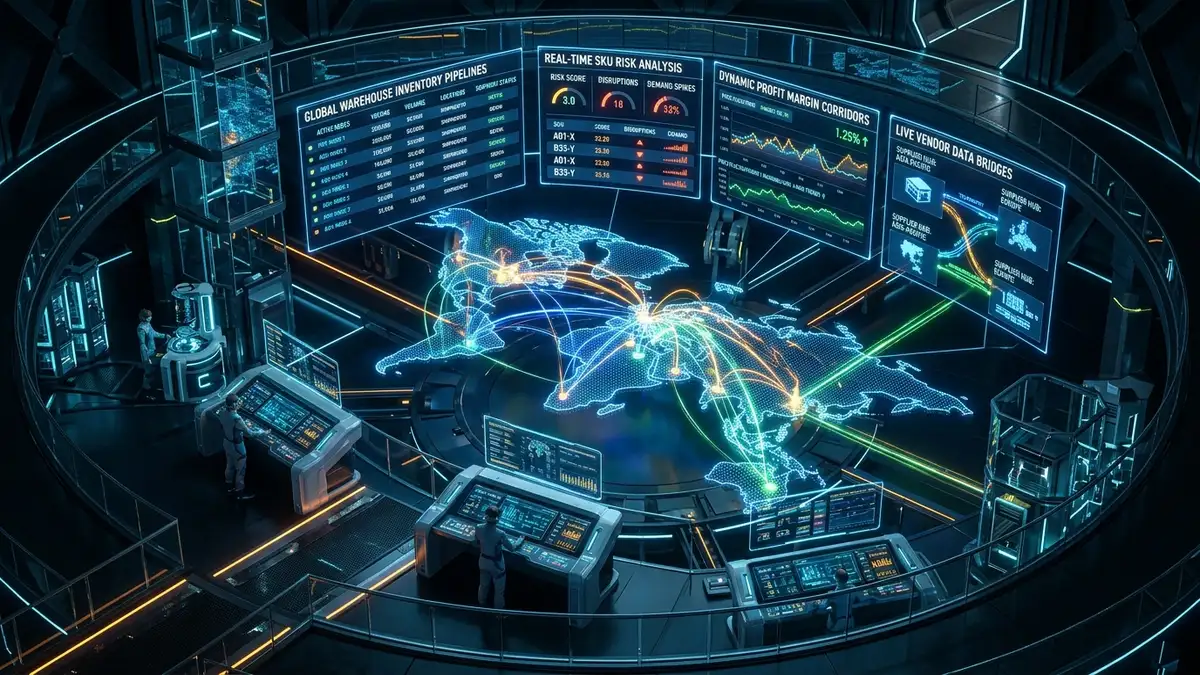
The Hidden Drain on E-Commerce Margins: Stockouts & Unannounced Price Spikes
Modern e-commerce retail operates in an environment of unprecedented supply chain velocity. For dropshippers, high-volume Amazon sellers, and hybrid multichannel merchants, success hinges on the tight coordination between frontend customer demand and backend vendor availability. When an online retailer scales from fifty orders a week to five hundred orders a day, the complexity of tracking upstream supplier data multiplies exponentially.
In our technical consulting engagements across scaling e-commerce enterprises at afolksdigital.com, we routinely discover that inventory discrepancies and unannounced wholesale price jumps represent the single largest hidden drain on net profitability. Retailers focus intensely on optimizing customer acquisition cost (CAC) and conversion rate, yet allow five to fifteen percent of their gross merchandise value (GMV) to evaporate through operational blind spots.
Consider the Anatomy of an Unmonitored Stockout: A trending lifestyle product goes viral on TikTok, generating four hundred orders over a weekend. Meanwhile, the primary wholesale distributor in Shenzhen or Los Angeles quietly exhausts their factory warehouse inventory on Friday evening. Because the merchant lacks real-time inventory synchronization, the storefront continues processing checkout payments unabated. By Monday morning, the seller must cancel hundreds of paid transactions, refund thousands of dollars, absorb non-refundable payment processor transaction fees, and face customer wrath on review platforms.
Even more pernicious than stockouts are quiet wholesale price escalations. Global suppliers routinely adjust base unit prices due to raw material inflation, currency fluctuations, or increased freight surcharges. If your supplier increases their unit cost from $24.00 to $33.00 while your retail listing remains static at $39.99 with free shipping, every subsequent sale burns through your operating capital, turning profitable products into cash-draining liabilities.
The Spreadsheet Fallacy: Why Manual Checks Inevitably Collapse at Scale
When starting an online store, almost every entrepreneur relies on spreadsheets. You download a weekly CSV stock list from your distributor, upload it to Excel or Google Sheets, run a VLOOKUP against your store catalog, and manually adjust quantities in your store admin. In the beginning, this routine seems manageable. However, as your catalog expands across hundreds of active Stock Keeping Units (SKUs) and multiple vendor networks, manual auditing rapidly turns into an operational bottleneck.
The primary vulnerability of spreadsheet management is latency. A spreadsheet represents a single, static snapshot frozen in time. Between the moment a supplier exports their inventory report and the time you finish updating your store backend, hours or days have elapsed. In fast-moving consumer goods, electronics, or apparel, vendor stock can fluctuate dramatically within a twenty-minute window.
Beyond latency, manual workflows are prone to human calculation error. An accidental column mismatch in an Excel formula can overwrite product prices with cost codes or misalign SKU variants, leading to catastrophic pricing errors where premium $250 goods are published for $25. Marketplace platforms like Amazon and eBay enforce unforgiving seller performance metrics; exceeding a 2.5% pre-fulfillment cancellation rate triggers immediate account suspension, asset freezes, and permanent loss of search ranking.
Protect your e-commerce margins and eliminate out-of-stock orders forever. Zelluvo synchronizes supplier stock counts, tracks wholesale price variations, and manages multi-vendor SKU redundancy automatically across Shopify, Amazon, and WooCommerce.
How Zelluvo Re-Engineers Monitoring: Architecture, Webhooks & SKU Sync
To break free from manual audits and fragile point-to-point scripts, modern retailers deploy dedicated supply chain intelligence engines. Zelluvo approaches inventory and price monitoring as an event-driven telemetry architecture rather than a batch-processing task.
At its core, Zelluvo establishes high-frequency ingestion pipelines that connect directly to diverse supplier endpoints: REST APIs, SFTP warehouse feeds, EDI electronic data exchanges, and structured catalog feeds. Once connected, Zelluvo constructs an internal relational graph between your store's retail SKUs and upstream distributor identifiers.
The platform operates through three synchronized core engines:
- Real-Time Stock Depletion Telemetry: Continuously monitors distributor warehouse buffers. When stock for a specific SKU drops below your defined safety threshold (for instance, fewer than 10 units remaining), Zelluvo triggers proactive buffer adjustments on your storefront to prevent cart collisions.
- Automated Wholesale Price Guard: Analyzes raw unit costs, freight tariffs, and supplier fee adjustments in real time. If a vendor raises their wholesale price, the platform recalculates gross margins against your predetermined pricing formulas and updates retail prices dynamically.
- Multi-Supplier Failover Redundancy: Maps identical catalog items across multiple competing distributors. If Vendor A runs out of stock, Zelluvo automatically shifts fulfillment priority to Vendor B without interrupting your storefront listing or forfeiting sales momentum.
By decoupling catalog updates from human intervention, Zelluvo transforms inventory management into a resilient, background automated service that runs 24 hours a day, 365 days a year.
Performance Comparison: Zelluvo Automated Sync vs. Spreadsheets vs. Scrapers
Choosing an inventory monitoring architecture requires evaluating sync frequency, error vulnerability, and maintenance overhead. The comparison table below illustrates the structural trade-offs between manual methods, basic native alerts, custom web scrapers, and automated platforms like Zelluvo:
| Monitoring Strategy | Update Frequency | Risk of Overselling | Multi-Vendor SKU Routing | Operational Overhead |
|---|---|---|---|---|
| Zelluvo Automated Telemetry Platform | Real-time to 15-minute intervals | Zero (<0.01% with safety buffers) | Full automated failover logic | Zero manual labor; set-and-forget |
| Manual Excel / Google Sheets Audits | Daily or weekly batch export | Extremely High (15% to 25% during promos) | None (Manual lookup required) | 15-30 hours per week of manual data entry |
| Custom Python / Puppeteer Scraper Bots | Hourly cron jobs | Moderate (Breaks when supplier HTML changes) | Requires complex custom scripting | Heavy maintenance & server hosting costs |
| Basic Storefront Stock Tracking (Shopify Native) | Internal orders only | High (Blind to external supplier changes) | None (Single inventory pool only) | Minimal setup, zero external intelligence |
As demonstrated by our architectural benchmarks, custom-built scraper scripts frequently fail when suppliers update website DOM layouts, implement CAPTCHAs, or throttle IP requests. In contrast, an enterprise-grade platform maintains managed connectors, ensuring continuous reliability without engineering headaches.
The 5-Step Operational Framework to Prevent Overselling and Stockouts
To establish an impenetrable supply chain defense across your online store, implement this five-step operational methodology:
Integrate your storefronts (Shopify, Amazon Seller Central, eBay, WooCommerce) into your central management dashboard. Connect your primary supplier data streams using native API integrations, private FTP credentials, or automated CSV feed URLs.
Map each store SKU to its corresponding vendor product ID. For best results, link each retail item to at least one primary supplier and one secondary backup vendor to establish instant failover capability.
Never display exact vendor warehouse counts on your store. Implement safety buffer rules: if a supplier has fewer than 5 units left, have your system automatically display 0 units available. This buffer absorbs simultaneous orders from other retailers drawing from the same wholesale pool.
Set minimum gross margin thresholds (such as minimum 30% margin or $15 fixed markup). If a supplier raises costs, let the automated engine adjust the retail price to preserve profitability, or unpublish the product if price elasticity makes the higher price uncompetitive.
Configure webhook notifications to your team Slack channel or operational email. When major catalog shifts occur (such as a top-selling SKU being discontinued), your procurement team receives instant alerts to evaluate alternative suppliers before customer orders are affected.
Dynamic Repricing & Margin Safeguards: Setting Intelligent Thresholds
Monitoring inventory availability is only half the battle. In competitive e-commerce markets, unmonitored supplier cost shifts can erode profitability just as quickly as a stockout. An item may remain in abundant supply, but if its wholesale cost climbs by 20%, continuing to sell at your existing retail price turns high-volume sales into financial losses.
Dynamic margin rules protect your bottom line by automating the mathematical relationship between cost of goods sold (COGS), marketplace commissions, merchant processing fees, shipping expenses, and target net profit:
// Automated E-Commerce Net Margin Protection Formula
RetailPrice = (SupplierCost + BaseShipping + PackagingCost) / (1 - MarketplaceFeeRate - ProcessingFeeRate - TargetNetMarginRate);

// Example Scenario:
// Supplier Cost: $35.00 | Shipping: $6.50 | Packaging: $1.00
// Marketplace Fee: 15% | Payment Fee: 2.9% | Target Net Margin: 22%
// Denominator: 1 - 0.15 - 0.029 - 0.22 = 0.601
// Protected Retail Price: $42.50 / 0.601 = $70.71
When automated systems detect that a supplier's base cost has increased from $35.00 to $42.00, the formula recalculates the protected retail price immediately ($49.50 / 0.601 = $82.36) and pushes the update to your Shopify, eBay, or Amazon listing. If the resulting price exceeds competitive ceiling thresholds, the system can automatically flag the product for review or pause marketing campaigns to protect return on ad spend (ROAS).
Enterprise Multichannel Scaling, Vendor Redundancy & Ecosystem Strategy
Scaling a modern retail brand requires diversifying across multiple sales channels and establishing supplier redundancy. If your entire business model depends on a single distributor with no backup sourcing, your enterprise remains vulnerable to sudden factory closures, logistics bottlenecks, or regional shipping disruptions.
At afolksdigital.com, our e-commerce engineering practice helps high-growth retail brands build multichannel architectures that integrate inventory feeds across regional warehouses, 3PL centers, and dropship suppliers. By orchestrating inventory through centralized platforms like Zelluvo, our clients achieve 99.9% order fulfillment rates while cutting manual administrative costs by up to 80%.
For store owners, financial controllers, and dropshipping operators modeling gross margins, payment processing overhead, and marketplace commission schedules, explore our interactive financial models on academy.afolksdigital.com to calculate exact breakeven pricing and capital requirements.
To train your internal merchandising and e-commerce engineering teams in advanced inventory API architectures, headless multichannel routing, and real-time webhook automation, explore our technical curriculums on learn.afolksdigital.com.