Amazon Aged Inventory Surcharge: 2026 Rates, FIFO Calculation & Storage Fee Elimination Guide

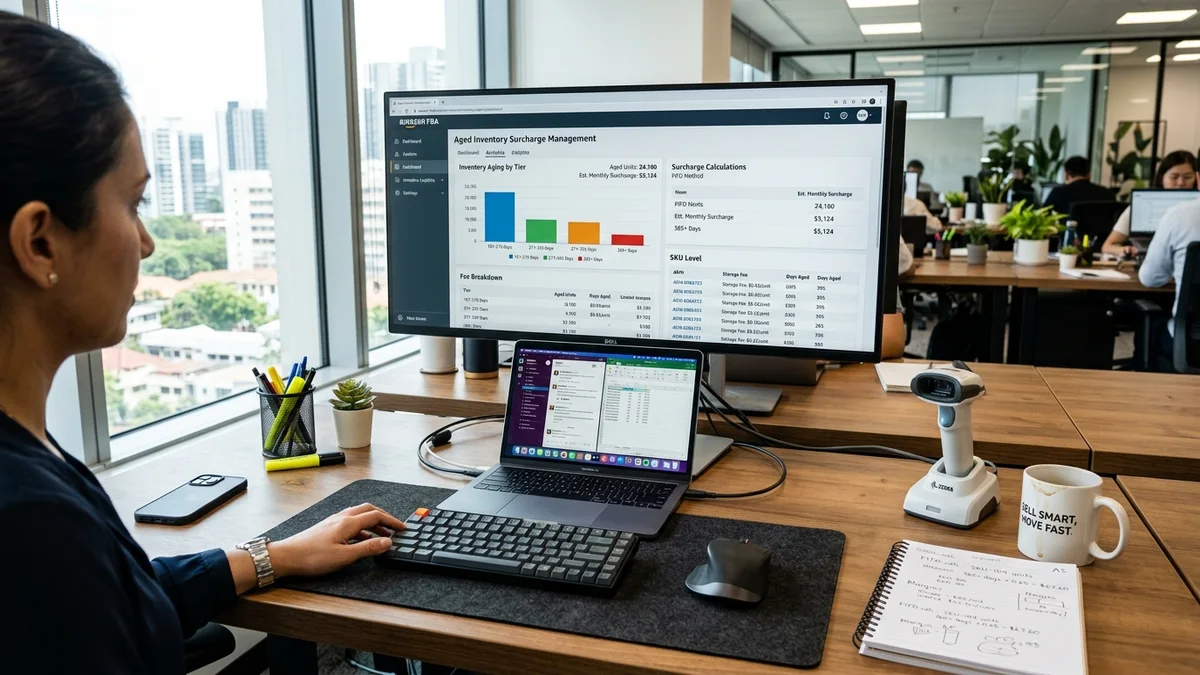
Quick Answer: How Amazon Calculates the Aged Inventory Surcharge
Amazon assesses the Aged Inventory Surcharge monthly between the 18th and 22nd on all FBA units stored longer than 180 days, scaling from $1.50 per cubic foot (days 181–210) up to $7.90 per cubic foot or $0.35 per unit (days 365+). Units are tracked on a strict First-In, First-Out (FIFO) basis across Amazon's entire fulfillment network. This surcharge is billed in addition to base monthly storage fees and the Storage Utilization Surcharge. To calculate your exact dollar exposure or simulate inventory reduction, run our free Amazon FBA Fee & Surcharge Calculator. Submitting a removal order, creating automated liquidation workflows, or triggering aggressive Outlet markdowns prior to the 18th freezes assessment and prevents profit erosion.
Table of Contents
- 1. The Financial Reality: Why Amazon Escalated Aged Storage Penalties
- 2. Official 2026 Aged Inventory Surcharge Rate Matrix
- 3. FIFO Accounting Mechanics: How Amazon Tracks SKU Age Across Warehouses
- 4. Mathematical Calculation: Step-by-Step Formula & Real-World Example
- 5. The Triple Surcharge Collision: Base Storage, Utilization Multipliers & Peak Rates
- 6. Five Practical Liquidation Strategies: Comparison & Recovery Yield Matrix
- 7. Proactive Inventory Hygiene: The 150-Day Surcharge Elimination Playbook
- 8. Frequently Asked Questions (FAQ)
1. The Financial Reality: Why Amazon Escalated Aged Storage Penalties
For years, Fulfilled by Amazon (FBA) merchants treated Amazon fulfillment centers as low-cost regional warehousing depots. Sellers would ship nine months of inventory from overseas factories in a single ocean container to capture freight volume discounts, comfortably storing surplus cartons on Amazon shelving until seasonal demand caught up. That era is definitively over.
Amazon fulfillment centers are engineered as high-velocity distribution hubs designed to turn over consumer goods within 30 to 60 days, not static storage warehouses. To discourage sellers from occupying precious cubic volume with slow-moving inventory, Amazon dismantled its old biannual Long-Term Storage Fee (LTSF) system and replaced it with aggressive, monthly Aged Inventory Surcharges that trigger at day 181.
Monthly Assessment Rhythm
Assessments occur monthly between the 18th and 22nd. Rather than facing a twice-a-year fee shock, sellers now experience continuous monthly cash-flow drain if products fail to sell.
Aggressive Day-181 Cliff
The surcharge begins at 181 days instead of the historical 365-day threshold. Holding stock beyond six months immediately triggers a $1.50/cu ft fee on top of standard monthly storage.
Per-Unit Minimum Floor
For items aged 365+ days, Amazon enforces a hard minimum of $0.35 per unit. For small, lightweight products like phone accessories or cosmetics, this per-unit fee can wipe out 100% of profit margins.
Without strict inventory monitoring, aged surcharges can silently consume tens of thousands of dollars in monthly working capital. Enterprise e-commerce brands managing multi-channel fulfillment must align their supply chains with precision. For high-growth DTC brands seeking comprehensive operations consulting, explore the digital logistics frameworks provided by our team at aFolksDigital.
2. Official 2026 Aged Inventory Surcharge Rate Matrix
Amazon segments inventory age into discrete 30-day brackets once units surpass 180 days in network custody. Understanding these exact tiers allows supply chain managers to project upcoming fee liabilities weeks in advance:
| Inventory Age Tier | Standard Monthly Surcharge Rate | Per-Unit Minimum Floor | Cumulative Impact Rating |
|---|---|---|---|
| 0 to 180 Days | $0.00 / cu ft (Exempt) | None | Healthy Velocity Zone |
| 181 to 210 Days | $1.50 / cu ft | None | Early Warning Tier |
| 211 to 240 Days | $1.85 / cu ft | None | Escalating Surcharge |
| 241 to 270 Days | $2.40 / cu ft | None | Moderate Cash Drain |
| 271 to 300 Days | $3.60 / cu ft | None | High Penalty Zone |
| 301 to 330 Days | $4.90 / cu ft | None | Severe Margin Loss |
| 331 to 365 Days | $6.15 / cu ft | None | Critical Margin Danger |
| 365+ Days (1 Year+) | $7.90 / cu ft | $0.35 / unit minimum | Catastrophic Destruction |
Notice the rate acceleration: between day 181 and day 365, the fee jumps by more than 426%. A seller storing 200 cubic feet of inventory that slips past 365 days pays $1,580 every single month in aged surcharges alone, completely separate from standard monthly storage fees.
3. FIFO Accounting Mechanics: How Amazon Tracks SKU Age Across Warehouses
A common misconception among private label sellers is that inventory age is determined on a per-warehouse or per-shipment basis. Sellers frequently ask: "If I shipped 500 units to Dallas six months ago and 500 units to California last week, which units are charged if Dallas units remain unsold?"
Amazon does not track physical warehouse placement for fee assessments. Instead, Amazon maintains a centralized, network-wide First-In, First-Out (FIFO) accounting ledger for every Merchant SKU (MSKU). Here is exactly how Amazon's ledger engine functions:
- Continuous Ingestion Timestamps: Whenever a shipment arrives and is checked into an FBA fulfillment center, each unit is stamped with a precise arrival timestamp.
- Automated Depletion Priority: Whenever a customer places an order, Amazon's fulfillment software credits that sale against the oldest available timestamp in your national inventory pool, regardless of which facility physically packages and ships the product.
- Customer Returns & Restocking Timestamps: When a customer returns an item and Amazon marks it as "Sellable", the unit re-enters your inventory pool with its original receipt timestamp. A return does not reset the clock; it retains its historical age and can trigger an aged surcharge immediately upon return.
- Removal Order Processing Lock: When you submit a removal or disposal order for 100 units of a SKU, Amazon immediately flags and deducts those units from your oldest inventory timestamps. This stops the surcharge clock from ticking even if fulfillment takes weeks.
Because FIFO continuously consumes the oldest stock first, healthy sales velocity naturally prevents units from reaching the 181-day mark. However, if sales velocity drops below inbound replenishment volume, inventory gradually ages across your entire catalogue.
4. Mathematical Calculation: Step-by-Step Formula & Real-World Example
Calculating your upcoming aged inventory surcharge requires three mathematical steps: calculating individual unit volume, converting into total cubic footage, and applying the corresponding tier rate.
The Core Mathematical Equations
Total Tier Surcharge ($) = Unit Volume × Aged Unit Quantity × Tier Rate ($/cu ft)
365+ Day Fee ($) = MAX(Total Tier Surcharge, Aged Unit Quantity × $0.35)
Note: 1,728 represents the number of cubic inches in one cubic foot (12 × 12 × 12).
Real-World Case Study: Calculating a 450-Unit Kitchen Appliance SKU
Consider an e-commerce seller marketing an electric coffee grinder with packaged carton dimensions of 10 in × 6 in × 5 in. The seller has 450 units remaining in FBA with the following age profile:
- Step 1: Calculate Unit Volume = (10 × 6 × 5) / 1,728 = 300 / 1,728 = 0.1736 cu ft per unit.
- Step 2: Breakdown by Age Brackets
- 150 units aged 120 days: Exempt ($0.00).
- 150 units aged 220 days (Tier: 211–240 days): Volume = 150 × 0.1736 = 26.04 cu ft. Rate = $1.85. Surcharge = 26.04 × $1.85 = $48.17.
- 100 units aged 290 days (Tier: 271–300 days): Volume = 100 × 0.1736 = 17.36 cu ft. Rate = $3.60. Surcharge = 17.36 × $3.60 = $62.50.
- 50 units aged 380 days (Tier: 365+ days): Volume = 50 × 0.1736 = 8.68 cu ft.
Cubic foot fee = 8.68 × $7.90 = $68.57.
Per-unit minimum = 50 × $0.35 = $17.50.
Applied fee = MAX($68.57, $17.50) = $68.57.
- Step 3: Total Monthly Aged Surcharge Liability = $48.17 + $62.50 + $68.57 = $179.24 per month.
Over a six-month stretch, this single SKU would cost the seller over $1,075 in aged penalties alone. If you also need to audit your product listing copy and conversion health to accelerate turnover, use our free Amazon Listing Validator to optimize title length and bullet point relevance.
Model Your True FBA Fee & Aged Storage Exposure Instantly
Calculate size tiers, referral fees, aged storage surcharges, and inbound placement costs inside your browser with zero data sharing.
Launch Free FBA Calculator →5. The Triple Surcharge Collision: Base Storage, Utilization Multipliers & Peak Rates
The most devastating financial hazard for an FBA brand is not just the Aged Inventory Surcharge alone—it is the catastrophic compounding of three separate storage assessments billed in parallel:
1. Standard Monthly Base Storage
Standard storage rates apply to every cubic foot you occupy: $0.78/cu ft (Jan–Sep) or $2.40/cu ft during Q4 peak season (Oct–Dec) for standard-size items.
2. Storage Utilization Surcharge
If your rolling average inventory-to-sales ratio exceeds 22 weeks, Amazon slaps an extra $0.44 to $2.84/cu ft surcharge onto your base storage rate across your entire warehouse inventory.
3. Aged Inventory Surcharge
Units past 180 days incur the tiered age fee, climbing to $7.90/cu ft for 365+ days. When all three collide in November or December, storage costs can exceed $13.00 per cubic foot per month!
Under this triple collision, storing unsold inventory for two months during Q4 can cost more than the original cost of goods sold (COGS). Financial discipline requires identifying aging units long before they cross the 180-day threshold. For analytical training on calculating portfolio risk and capital allocation models, explore the financial curricula at aFolks Trading Academy.
6. Five Practical Liquidation Strategies: Comparison & Recovery Yield Matrix
When units approach 150 days in FBA, doing nothing is the costliest decision. Sellers have five operational liquidation paths to eliminate aged storage exposure. Each involves distinct trade-offs between cash recovery, brand equity protection, and execution speed:
| Liquidation Method | Expected Capital Recovery | Execution Speed | Impact on Brand & Sales Rank |
|---|---|---|---|
| 1. Amazon Outlet Deals & Markdowns | 60% – 85% of retail price | Fast (1 to 2 weeks) | Boosts BSR and organic review volume |
| 2. FBA Liquidations Program | 5% – 10% of average selling price | Automatic (30 to 60 days) | Neutral (Sold to secondary wholesale liquidators) |
| 3. Removal to Third-Party Prep (3PL) | 100% (Resold via TikTok Shop / eBay) | Moderate (14 to 30 days) | Preserves MSRP; requires external warehouse space |
| 4. Aggressive PPC / Deal Vouchers | 40% – 70% (After ad spend) | Very Fast (3 to 7 days) | Reactivates dormant ASIN indexing |
| 5. Amazon Disposal Order | $0.00 (Total Loss + Disposal Fee) | Immediate fee freeze | Tax write-off only; irreversible destruction |
7. Proactive Inventory Hygiene: The 150-Day Surcharge Elimination Playbook
The most profitable Amazon brands never pay aged inventory surcharges. They institutionalize a systematic four-phase operational workflow that triggers automated interventions before units cross the 180-day threshold:
The 4-Phase Inventory Velocity Protocol
- Phase 1: Day 90 Velocity Health Check — Inspect your Inventory Performance Index (IPI) dashboard and SKU-level sell-through rates. If rolling 90-day unit velocity indicates more than 120 days of forward supply, halt automated restocking shipments immediately.
- Phase 2: Day 120 Promotional Push — For units entering the 120–150 day window, activate tiered digital coupons (15% to 25% off) and test PPC campaign expansions on competing brand conquesting targets to accelerate unit run rate.
- Phase 3: Day 150 Automated Outlet Clearance — If stock remains, submit eligible ASINs to the Amazon Outlet Deals portal. Alternatively, launch a 35% Prime Exclusive Discount. Selling at breakeven recovers your full cost of goods while generating vital cash flow.
- Phase 4: Day 175 Strategic Removal Order — Exactly three days before the monthly snapshot (on the 15th of the month), review your FBA Inventory Age report. Submit removal orders for all units entering the 181-day tier that cannot sell through within 72 hours. Submitting the order immediately halts the fee assessment.
For engineering and supply chain teams looking to automate their inventory tracking scripts and build internal developer dashboards, reference the coding tutorials on our educational learning platform.
8. Frequently Asked Questions (FAQ)
What is the Amazon Aged Inventory Surcharge and when does it apply?
The Amazon Aged Inventory Surcharge (formerly referred to as the Long-Term Storage Fee) is a monthly assessment levied on units stored in Amazon fulfillment centers for more than 180 days. Assessed between the 18th and 22nd of each month, the fee scales across tiered duration brackets starting at $1.50 per cubic foot for items aged 181 to 210 days and climbing to $7.90 per cubic foot (or $0.35 per unit, whichever is greater) for inventory stored beyond 365 days.
How does Amazon determine which units are subject to aged inventory fees?
Amazon operates on a strict First-In, First-Out (FIFO) accounting basis across its entire fulfillment network. When a customer purchases a SKU, Amazon automatically deducts that sale from the oldest units received into fulfillment centers, regardless of which physical warehouse fulfills the customer package. Inventory age is tracked from the exact calendar day units are marked available for sale.
What is the exact mathematical formula to calculate the aged inventory fee?
First, determine unit volume in cubic feet: (Length in inches × Width in inches × Height in inches) / 1,728. Then multiply by the number of aged units in that specific age tier and apply the tier's cubic foot rate: Fee = Unit Volume (cu ft) × Aged Unit Quantity × Tier Rate ($/cu ft). For units aged 365+ days, calculate both the cubic foot fee and the unit minimum ($0.35 × quantity); Amazon charges whichever sum is higher.
Can the Aged Inventory Surcharge stack with the Storage Utilization Surcharge?
Yes. The Aged Inventory Surcharge is an item-specific aging penalty assessed on units exceeding 180 days. The Storage Utilization Surcharge is an account-level penalty applied to your entire monthly base storage rate if your rolling storage utilization ratio exceeds 22 weeks. If you hold slow-moving inventory, you pay regular base monthly storage, the storage utilization multiplier, and the aged inventory surcharge simultaneously.
How can sellers avoid the aged surcharge before the monthly snapshot date?
Sellers have three primary options before the 18th of each month: (1) Submit a removal or disposal order in Seller Central—once a removal order is submitted, units are immediately excluded from that month's surcharge assessment; (2) Enroll excess units in FBA Liquidations to recover 5% to 10% of wholesale value; or (3) Run steep limited-time Prime Exclusive Discounts or Amazon Outlet deals to accelerate sell-through.
Does submitting a removal order prevent aged surcharges if Amazon takes weeks to process it?
Yes. As long as you submit the removal or disposal order before 11:59 PM PT on the 17th of the month, Amazon freezes fee assessments for those units immediately, even if warehouse logistics take 30 to 60 days to physically pick, pack, and return the items to your facility.