Amazon Returns Processing Fee: 2026 Category Thresholds, Return Rate Calculator & Fee Avoidance Guide

Quick Answer: How Amazon Returns Processing Fees Impact Sellers in 2026
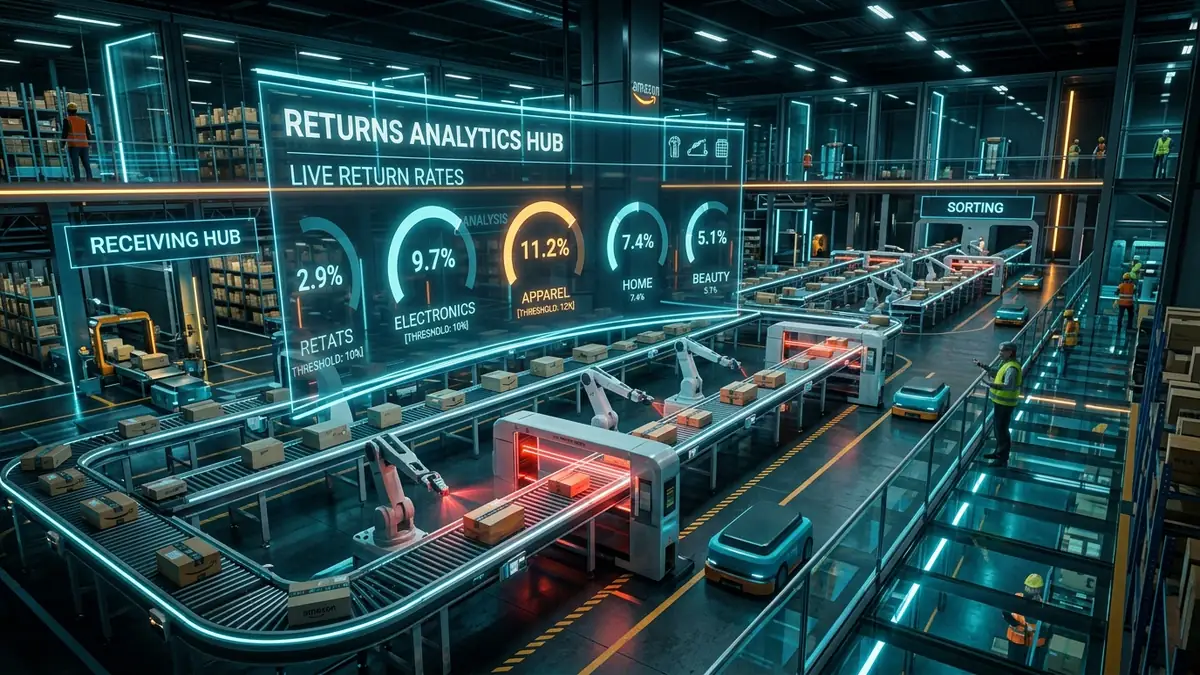
Amazon now penalizes high-return FBA products across almost all merchandise categories once your 3-month trailing return rate exceeds category benchmarks (ranging from 2.9% to 12.8%). Unlike apparel where every single return incurs a fee, non-apparel products are billed strictly on returns exceeding the published threshold. Low-volume products shipping under 25 units per month and early enrollments in the FBA New Selection program remain completely exempt. Calculate fee exposure across your catalog before surprise charges land in your monthly settlement sheet using our local Amazon FBA Profit & Returns Processing Calculator.
Table of Contents
- 1. The 2026 Policy Shift: From Apparel-Only to Catalog-Wide Penalties
- 2. The 3-Month Trailing Evaluation Window & Mathematical Formula
- 3. 2026 Category Return Rate Thresholds & Benchmark Table
- 4. Size Tier Surcharge Rate Card: Standard vs Large Bulky Surcharges
- 5. Critical Exemptions: The 25-Unit Rule and FBA New Selection Shield
- 6. Interactive Calculator Walkthrough & Scenario Modeling
- 7. Financial Impact Matrix: Threshold Breach vs Optimized Packaging
- 8. 5-Point Playbook to Slash Returns and Eliminate FBA Penalties
- 9. Frequently Asked Questions (PAA Answers)
1. The 2026 Policy Shift: From Apparel-Only to Catalog-Wide Penalties
For years, Amazon third-party sellers outside the apparel and footwear categories operated under a straightforward fulfillment model. When a customer returned an item, the seller surrendered the original FBA fulfillment fee, absorbed a 20% concession on the referral fee, and received the unsellable or restockable merchandise back at the fulfillment center without incurring a dedicated processing surcharge. That era ended decisively. Amazon expanded the Returns Processing Fee to encompass high-return products across virtually every physical merchandise category.
The financial rationale from Amazon's perspective centers on fulfillment center economics. Reverse logistics consume immense floor space, manual intake labor, quality inspection screening, and re-warehousing routing. In 2026, Amazon refuses to subsidize customer returns caused by vague product listings, fragile packaging, or inaccurate sizing details. By shifting processing overhead directly onto merchants whose products generate return rates above category norms, Amazon forces brand owners to inspect upstream supply chain quality.
Sellers who fail to monitor their return rates risk severe margin compression. A product netting an 18% operating margin can turn unprofitable within ninety days if returns spike beyond category benchmarks. Because Amazon assesses these charges retrospectively on a rolling 3-month trailing window, merchant accounting teams often fail to recognize the bleeding until thousands of dollars in surprise surcharges drain their bi-weekly disbursement.
Understanding the mechanics of this fee requires analyzing the category threshold matrix, the mathematical return formula, the size tier cost tables, and the official operational exemptions. Armed with granular data, brands can audit problem ASINs, adjust product documentation, and defend their bottom-line cashflow.
2. The 3-Month Trailing Evaluation Window & Mathematical Formula
The most common mistake sellers make when auditing return fees in Seller Central is looking at single-month return tallies. Amazon does not calculate return rates based on the units returned during a specific calendar month compared to the units shipped in that same month. Instead, the algorithm measures customer returns over a prolonged 3-month trailing cohort window to account for standard customer return lag.
Specifically, for all units shipped in Month M, Amazon tracks customer returns across Month M, Month M+1, and Month M+2. Consider units shipped during June. The return cohort for those June shipments remains open through July 31 and August 31. Only after August closes does Amazon compile the final return tally. The formal mathematical equation appears below:
Once the return rate is computed, Amazon compares it against the established category threshold. If the return rate falls below or matches the threshold, the fee is zero. If the return rate exceeds the threshold, the fee is applied strictly to the excess units:
Total Surcharge = Chargeable Units × Per-Unit Fee (by Size Tier & Shipping Weight)
Because of this 90-day cohort tracking lag, fees for shipments dispatched in June are processed and debited from seller accounts between the 7th and 15th of September. This delayed billing cycle catches unprepared merchants off guard. When seasonal spikes occur during Prime Day or Q4 holiday shopping, return fee adjustments hit accounts months later during cashflow troughs in January or February.
3. 2026 Category Return Rate Thresholds & Benchmark Table
Amazon does not enforce a single blanket return threshold across its entire catalog. Consumer electronics naturally exhibit lower baseline returns than complex kitchen machinery or fitness gear. Amazon analyzed millions of historical customer orders to establish baseline return rate thresholds for each subcategory.
In the official 2026 fee schedule, category return thresholds range from a low of 2.9% up to 12.8%. If your product category allows a 7.5% threshold and your ASIN achieves a 6.8% return rate, you pay zero dollars in returns processing surcharges. If your return rate climbs to 10.2%, you pay penalties on the 2.7% delta. The operational exception remains Apparel and Shoes, where zero thresholds exist and every returned unit generates a fee.
| Product Category | Return Threshold (%) | Apparel Rule Exception | Risk Profile |
|---|---|---|---|
| Apparel & Footwear | 0.0% (No Threshold) | Charged on 100% of returns | Extremely High |
| Consumer Electronics | 4.8% | Threshold applies | Moderate |
| Home & Kitchen Appliances | 7.6% | Threshold applies | High |
| Sports & Fitness Equipment | 6.2% | Threshold applies | Moderate |
| Beauty & Personal Care | 3.8% | Threshold applies | Low |
| Automotive & Powersports | 5.4% | Threshold applies | High (Fitment issues) |
| Office Products & Stationery | 3.2% | Threshold applies | Low |
| Pet Supplies & Accessories | 5.1% | Threshold applies | Low to Moderate |
Notice the severe risk in categories prone to technical misconfiguration or physical fitment questions. Automotive replacement parts face strict 5.4% thresholds, yet buyers frequently purchase incorrect model years without reading bullet points. When those parts bounce back to FBA warehouses, sellers foot the return shipping bill and the processing penalty simultaneously.
4. Size Tier Surcharge Rate Card: Standard vs Large Bulky Surcharges
When an ASIN crosses its return threshold, how much does Amazon charge per excess unit? The rate card follows Amazon's established dimensional size tier matrix, scaling directly with shipping weight and cubic volume. Handling a returned smartphone screen protector costs fulfillment centers far less time and pallet volume than inspecting and repacking an electric stand mixer.
Under the 2026 published rate card, fees break down across three primary structural tiers:
- Small Standard-Size (under 16 oz): Ranging from $1.78 for packages weighing 2 oz or less, up to $2.26 for items approaching 16 oz.
- Large Standard-Size (1 to 20 lbs): Ranging from $2.82 for items under 1 lb, climbing to $3.48 for 2-lb parcels, plus $0.18 per additional half-pound up to 20 lbs.
- Large Bulky & Extra-Large (over 20 lbs or oversized dimensions): Base fee starts at $5.80, scaling rapidly past $12.50 per unit based on dimensional weight calculations.
For a brand selling 2,000 units per month of a 3-lb kitchen blender ($3.84 per unit surcharge tier), crossing a 7.6% return threshold with an actual 11.6% return rate generates 80 chargeable return units per month. That translates to an unexpected $307.20 penalty every single month on a single SKU, or over $3,680 across the calendar year. Across a catalog of thirty active ASINs, unmanaged return surcharges can wipe out five-figure annual profits.
5. Critical Exemptions: The 25-Unit Rule and FBA New Selection Shield
Amazon recognized that statistical noise in low-volume sales can distort return percentages. If a newly launched product sells 4 units in its first month and one customer returns an item due to postal damage, the mathematical return rate is 25%. Penalizing a seller based on a sample size of four would unfairly punish product innovation.
To prevent statistical distortions, Amazon codified two critical operational safeguards into the policy:
The 25-Unit Monthly Volume Safeguard
Any child ASIN shipping fewer than 25 units in a calendar month is 100% exempt from the Returns Processing Fee for that shipment cohort. Even if 10 out of 20 units are returned (a 50% return rate), zero return surcharges are assessed.
FBA New Selection Program Waiver
Eligible parent ASINs enrolled in the FBA New Selection program receive a full fee waiver on the first 20 returned units. This provides a testing runway for new brand launches to calibrate sizing, copy, and customer expectations without penalty.
Savvy brand managers use the 25-unit rule strategically when winding down legacy inventory or testing niche product variants. If sales on an older SKU drop below 25 units per month, the risk of return penalties evaporates entirely, allowing clean inventory liquidation without reverse logistics drag.
Calculate Your ASIN Return Rate Threshold Penalties Locally
Never guess what Amazon will debit from your settlement account in three months. Run your monthly unit sales, category threshold, historical return counts, and size tiers through our privacy-first local calculator. Everything computes in browser memory with zero data transmitted to third parties.
7. Financial Impact Matrix: Threshold Breach vs Optimized Packaging
To visualize how returns processing surcharges erode Amazon FBA profitability, consider a consumer electronics brand selling an ergonomic wireless keyboard (1.4 lbs, Large Standard-Size). The category return threshold is 4.8%. The table below illustrates three distinct operational scenarios across an identical 1,500 monthly unit sales volume:
| Operational Metric | Scenario A (Severe Breach) | Scenario B (Moderate Breach) | Scenario C (Threshold Compliant) |
|---|---|---|---|
| Monthly Units Shipped | 1,500 units | 1,500 units | 1,500 units |
| Actual 3-Month Return Rate | 8.8% (132 returns) | 6.2% (93 returns) | 4.4% (66 returns) |
| Category Threshold (4.8%) Allowance | 72 allowed units | 72 allowed units | 72 allowed units |
| Units Subject to Surcharge | 60 penalty units | 21 penalty units | 0 penalty units |
| Per-Unit Returns Surcharge Tier | $3.12 / unit | $3.12 / unit | $0.00 / unit |
| Monthly Surcharge Debited | -$187.20 | -$65.52 | $0.00 (Fully Waived) |
| Annualized Margin Loss | -$2,246.40 | -$786.24 | $0.00 Savings |
Under Scenario A, customer confusion regarding Bluetooth pairing drove the return rate up to 8.8%. The resulting annual fee of $2,246.40 represents pure margin destruction. By contrast, Scenario C invested $150 in a printed quick-start installation card placed inside the keyboard carton, cutting customer returns to 4.4% and saving over $2,000 annually.
8. 5-Point Playbook to Slash Returns and Eliminate FBA Penalties
Avoiding Amazon's Returns Processing Fee requires proactive operational discipline rather than reactive accounting adjustments. Our e-commerce consulting practice at aFolksDigital deploys a battle-tested five-point operational framework across six- and seven-figure brand catalogs:
1. Scrape and Cluster Seller Central Return Reason Codes Weekly
Never look at returns as a single unified metric. In Seller Central, navigate to Reports → Fulfillment → FBA Customer Returns. Export raw CSV records and cluster return disposition reasons. Are buyers returning your product because it "Does not match website description", "Defective / Does not work", or "Missing parts"? If 60% of returns cite "Does not match description", your copywriter created false expectations that your listing photos must immediately correct.
2. Deploy Hyper-Visible Dimensional Callouts in Secondary Images
Customer spatial estimation is notoriously inaccurate. If you sell home goods, organizers, or backpacks, text descriptions stating "14 inches x 8 inches x 6 inches" fail to register with mobile shoppers. Replace generic lifestyle photos with high-contrast dimensional graphics showing the product next to common everyday items (a standard smartphone, a water bottle, or a laptop). Eliminate buyer surprise before the carrier truck delivers the parcel.
3. Insert Color-Coded Quick-Start Guide Cards in Product Packaging
Over 35% of electronics and tool returns stem from customer setup errors rather than hardware defects. When a customer cannot pair a device within five minutes, they initiate an Amazon return and request a refund. Inserting a bold, physical 4x6-inch quick-start troubleshooting card right under the carton lid with step-by-step pairing visuals and customer support contacts prevents immediate return requests.
4. Enforce Structural Drop-Test Packaging Standards with 3PL Suppliers
Amazon fulfillment centers move packages through automated high-speed conveyor belts and sortation chutes. Flimsy factory polybags or thin single-wall cardboard boxes often arrive with crushed corners. Even when the interior item remains undamaged, customers perceive the product as refurbished or defective and demand an instant replacement. Upgrading to rigid 350 GSM corrugated cardboard or corner-reinforced foam prevents transit scuff returns.
5. Coordinate Multi-Channel Liquidations for Chronic Offender ASINs
Some products suffer from flawed manufacturing molds or inherent design limitations that make low return rates mathematically impossible. For chronic offender ASINs consistently generating 15%+ return rates, continuing FBA fulfillment drains working capital through stacked fulfillment, storage, and return penalties. Liquidate stock across off-Amazon channels, or transition the ASIN to Merchant Fulfilled Network (FBM) where returns processing fees do not apply. For developer tutorials and supply chain optimization frameworks, explore educational courses on our aFolks Learn Platform.
9. Frequently Asked Questions (PAA Answers)
What is the Amazon Returns Processing Fee in 2026?
The Returns Processing Fee is a per-unit operational surcharge charged to FBA sellers when a product's return rate exceeds its specific category threshold. In categories other than apparel and footwear, the fee applies solely to returned units above the category threshold. For apparel and footwear, the fee is charged on every single returned unit without any threshold exemption.
How does Amazon evaluate customer return rates across time?
Amazon calculates return rates using a 3-month trailing window. The return rate for units shipped in Month M equals total customer returns received in Month M, Month M+1, and Month M+2 divided by total units shipped in Month M. Surcharges are assessed and billed between the 7th and 15th of the third subsequent month.
Which products are fully exempt from the Returns Processing Fee?
Products shipping fewer than 25 units within a calendar month are completely exempt under the low-volume safeguard. Additionally, new-to-FBA parent ASINs enrolled in the FBA New Selection program receive full fee waivers on their first 20 returned units.
How much does the Returns Processing Fee cost per unit?
Fees scale by package size tier and shipping weight. Small standard items (under 2 oz) start around $1.78 per returned unit above threshold, large standard items (1 to 1.5 lbs) cost $2.82 to $3.50, and large bulky goods range from $5.00 to over $12.00 per unit. Review full policy guidelines on Amazon Seller Central Returns Fee Guidelines.
How can sellers lower their return rates to avoid threshold penalties?
Sellers eliminate threshold surcharges by updating listing images with precise dimensional callouts, clarifying customer sizing charts, sealing outer product cartons against transit scuffs, inserting quick-start setup cards to resolve customer confusion, and monitoring weekly return reason codes in Seller Central.